The Manga Nouvelle exhibition, presented at the French Institute of Larissa, brought together contemporary French manga and illustration within a local Greek cultural setting.
Organised by the French Institute of Larissa, COMMEDI and LoudMouse Crew, the exhibition took place from 25 May to 7 June 2026 as part of the European CERV–SONDER programme. It featured works by five contemporary French creators working in manga and illustration, while also including educational and participatory activities for younger audiences.
At first glance, the event can be understood as an exhibition of contemporary visual work. Its wider interest, however, lies in the way it reflects the international development of manga as a form.
Although manga originates in Japan, it has become deeply embedded in French popular and artistic culture. France is one of the strongest European markets for manga, and a growing number of French creators now work within the medium, combining Japanese visual influences with local themes, narrative traditions and artistic approaches.
The Larissa exhibition presented this development to a Greek audience, creating a small but significant point of contact between three different cultural environments: Japan as the historical origin of manga, France as a major European centre of manga production and readership, and Greece as an expanding space for independent comics, illustration and youth-led visual culture.
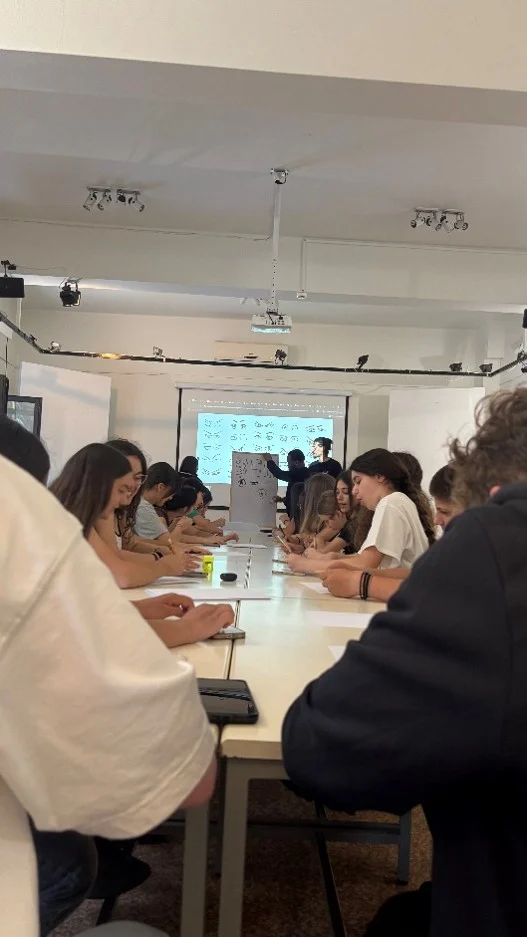
One of the participating artists was JUST LOUI, creator of RedFlower Stories and RedFlower, who also took part in the accompanying manga and illustration workshop. The workshop introduced children and teenagers to practical elements of visual storytelling, including character creation, expression, movement and composition.
This educational aspect was central to the event. Rather than treating manga only as a finished cultural product, the workshop focused on the creative process behind it. Participants were encouraged to understand how stories are constructed through images and how visual choices shape character, atmosphere and meaning.
From a sociological perspective, this is particularly relevant because manga has become part of the everyday cultural language of younger generations. Many young readers encounter it not only through printed books, but also through animation, gaming, fan communities and digital platforms.
As a result, manga often functions as more than a foreign artistic influence. It becomes a shared transnational language through which younger people explore identity, fantasy, social roles and personal expression.
The exhibition also highlighted the importance of regional cultural institutions. Events of this kind are often concentrated in major cities, yet their presence in Larissa demonstrates that international cultural exchange can also take place through local organisations, workshops and community-based initiatives.
The French Institute provided an institutional setting, while the involvement of COMMEDI and LoudMouse Crew helped connect the exhibition with local creative networks and younger audiences.
The inclusion of manga within such a setting also reflects a broader shift in how cultural institutions approach popular visual forms. Manga, comics and illustration are increasingly recognised not only as entertainment, but as artistic and narrative media capable of addressing complex themes and reaching diverse audiences.
Manga Nouvelle therefore operated on several levels. It presented the work of contemporary French creators, introduced local audiences to current developments in European manga, and offered young participants practical access to visual storytelling. The contribution of COMMEDI and the SONDER programme was central to the development of the exhibition. Through SONDER’s focus on participation, intercultural dialogue and inclusive cultural activity, the event was designed not simply as a display of artworks, but as a platform for exchange between artists, institutions and local audiences. COMMEDI played a key coordinating role, connecting the European framework of the project with the cultural and educational context of Larissa and helping transform the exhibition into a broader participatory experience.